Fusion_01_why_Fusion
Why we need Fusion Energy?
Why we need Fusion?
Energy has always been one of the primary constraints on human civilization. Today, AI is bringing rapid improvements to everyday life, but it also requires enormous amounts of electricity to train and run models at scale. Recent projections estimate that global electricity used to supply data centres is about 460 TWh per year today and could rise to over 1,000 TWh by 2030, potentially reaching around 1,300 TWh by 2035 as AI workloads expand. At the same time, power systems are under pressure: in the United States, electricity generators plan to retire 12.3 GW of capacity in 2025, and coal accounts for roughly two-thirds of those retirements. Meanwhile, wind and solar are growing quickly, but their output is weather-dependent, so they cannot always provide power exactly when and where it is needed without large investments in storage, transmission, and flexible grid operations.
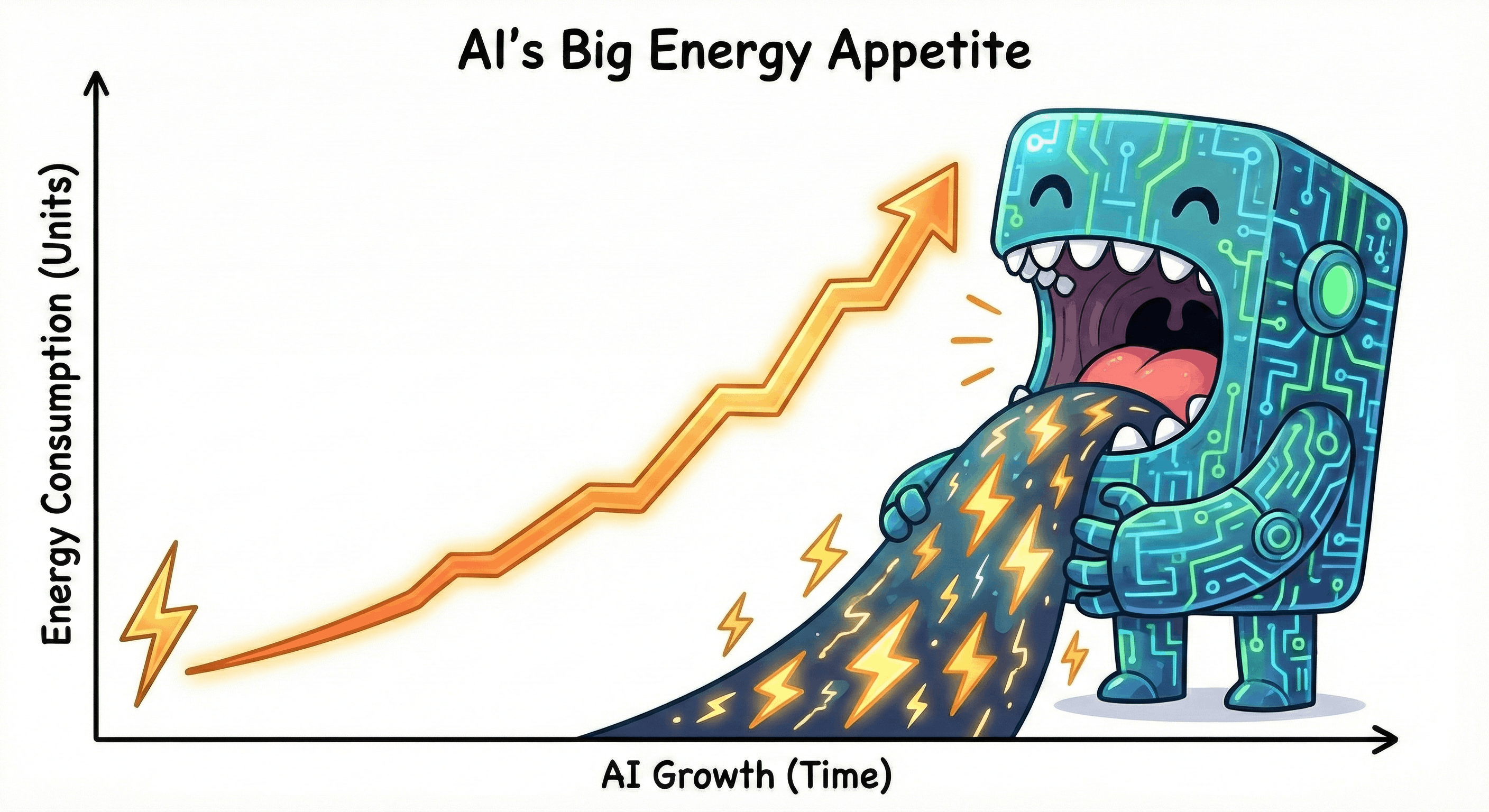
This is why nuclear energy remains central in the discussion of clean and reliable power. Nuclear fission is already a proven source of firm, low-carbon electricity at scale; for example, the U.S. nuclear fleet has operated at about a 92% capacity factor in recent years, meaning it delivers steady output day and night across seasons. Looking further ahead, however, the most inspiring possibility is nuclear fusion. If we can harness it, fusion could provide abundant, high-density energy with near-zero carbon emissions during operation, and it would generate far less long-lived radioactive waste than nuclear fission.
What is Nuclear Fusion?
In the classic fusion reaction—the deuterium–tritium (D–T) reaction—a deuterium nucleus collides with a tritium nucleus (both are isotopes of hydrogen) and they fuse to form a helium nucleus and a neutron:
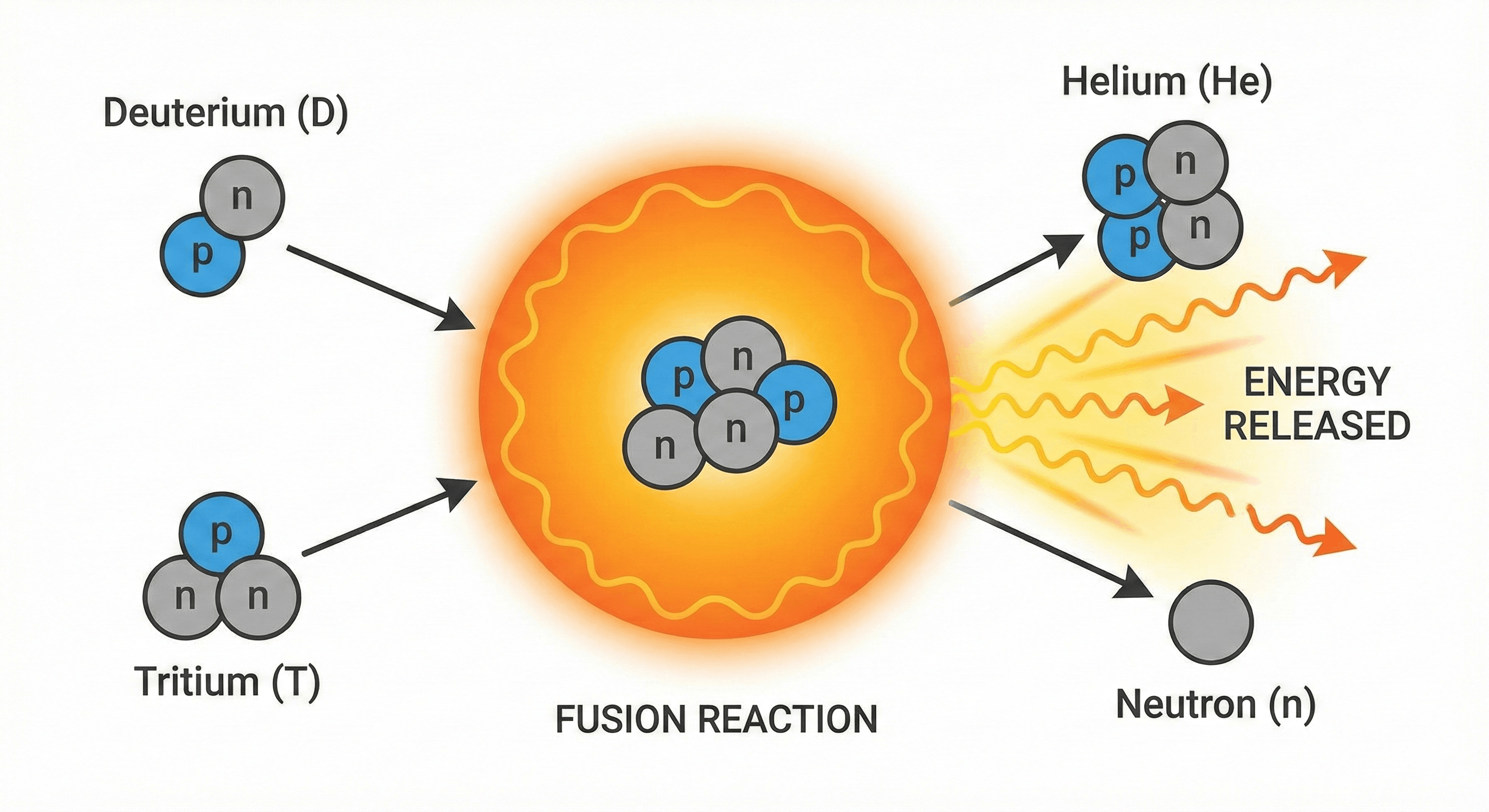
But where does the 17.6 MeV come from? The answer is the most famous equation in physics:
\[E = mc^2\]In nuclear reactions, “mass” is really a form of energy. If the total mass of the products is slightly smaller than the total mass of the reactants, the missing mass (called the mass defect) is released as energy:
\[\Delta m = \big(m_{\mathrm{D}} + m_{\mathrm{T}}\big) - \big(m_{\mathrm{He}} + m_{\mathrm{n}}\big) > 0, \qquad Q = \Delta m\,c^2\]For D–T fusion, this mass defect corresponds to:
\[Q \approx 17.6~\mathrm{MeV}\]Physically, that released energy mostly becomes kinetic energy of the reaction products (they fly away fast):
- about 14.1 MeV goes to the neutron,
- about 3.5 MeV goes to the helium nucleus (also called an “alpha particle”).
In a fusion power plant, those fast particles collide with surrounding material (or plasma), gradually converting their kinetic energy into heat, which can then be turned into electricity—just like in any thermal power station.
How close are we?
Humanity has already proven fusion is possible: the hydrogen bomb is a fusion device. But that is uncontrolled fusion—a one-time explosion. What we need for energy is controlled fusion: create a plasma, keep it stable, extract heat reliably, and repeat it safely and economically.
So how close are we? Physics is progressing fast; engineering is the bottleneck. We have seen major milestones: laser-driven fusion has demonstrated “ignition” in the sense that the fuel released more fusion energy than the laser energy delivered to it, and tokamak experiments have produced record D–T fusion shots (tens of megajoules) showing that high-performance fusion plasmas are real. We have also made progress on duration: modern devices can sustain hot plasmas for minutes, not just seconds.
But net electricity is still ahead. A power plant must produce more energy than the entire facility consumes and do it continuously, while surviving extreme heat loads and neutron radiation, and (for D–T fusion) closing the tritium fuel cycle.
That is why the main route to controlled fusion focuses on magnetic confinement, especially tokamaks and stellarators:
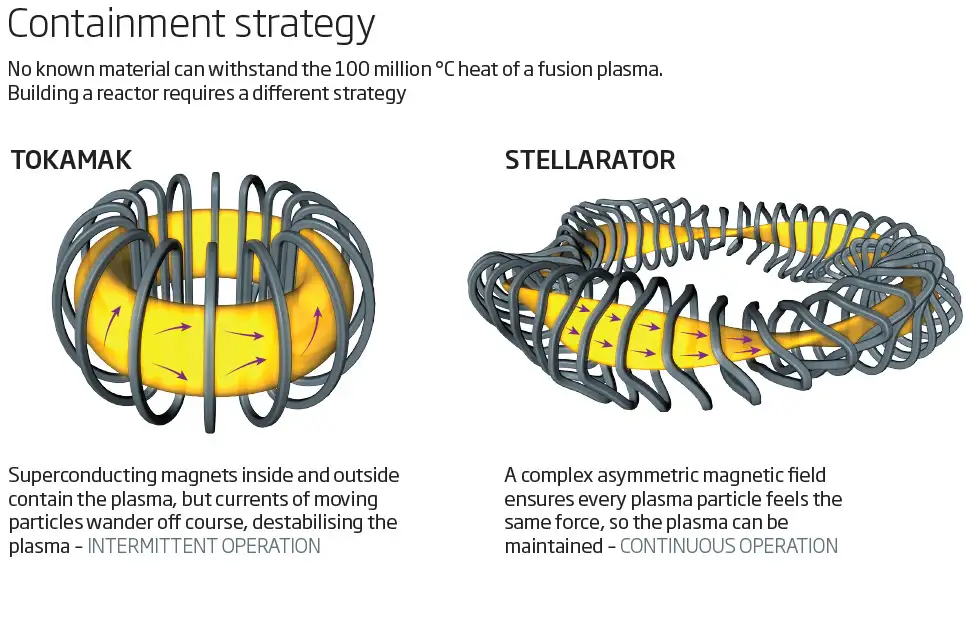
- Tokamak: strongest performance track record, but steady operation is challenging due to plasma current and disruption control.
- Stellarator: more complex magnets, but naturally suited for steady-state operation with fewer disruption risks.
In short: we are past “does fusion work?” and now stuck on “can we make it run like a power plant?”—which is exactly why tokamaks and stellarators matter.